Pages

Wednesday, November 23, 2011

The Story of Silent Night, Stille Nacht


It's the first line from a poem this young Austrian priest had written two years before. Now he can't get the phrase out of his mind. "Silent night, holy night."
Tonight is Christmas Eve and St. Nicholas Church in Oberndorf, north of Salzburg, will be chock-full of people. Father Joseph Mohr has a homily in mind, a message for his flock on this sacred night, but he needs a carol, something special to cap off the service.
Silent night, holy night, 
All is calm, all is bright...
The words won't go away. "I need a tune!" he says out loud, shaking his head. "I wonder if Franz can help me. I hope it's not too late." Franz Gruber is the schoolteacher in the nearby village of Arnsdorf -- a gifted musician, organist at the Arnsdorf church, and occasional substitute organist at St. Nicholas. "Franz will help me!" he says to himself. "He can't resist a musical challenge."

Franz Gruber, Schoolteacher and Organist

Quickly now he slings on his heavy coat, dons a fur cap and gloves, and ventures into the brisk December morning. The snow is crunchy underfoot as he makes his way across the churchyard towards Arnsdorf, just a 20 minute walk. "Silent night, holy night ... silent night, holy night." The rhythm of the words echoes with each step.
Elizabeth opens the door at his knock. "Father Mohr, how nice of you to stop by. Franz will be glad to see you." She takes his coat and ushers him in. Franz is picking something out on his guitar.
"Franz, remember that poem I told you about: 'Silent Night'?" says Mohr. "I know it's too late to ask, but could you help put a tune to it? I want to sing it tonight for Christmas Eve."
Gruber's face lights up. A challenge. A song. He takes the lyrics from the priest and begins to say them over and over, looking for a cadence. Then he hums a line and scratches it down.
Mohr soon tires of the process and begins to play with the children. But within an hour or so, Gruber seems to have a melody and is working out the chords on his guitar. "Father, how does this sound?" he calls and begins to sing the words:
Silent night, holy night,
All is calm all is bright...
He stops to make a correction in the manuscript, and then continues:
...'Round yon virgin, Mother and Child,
Holy infant so tender and mild,
Sleep in heavenly peace!
Father Mohr is ecstatic. On the second verse Gruber's deep voice is joined by Mohr's rich tenor. Elizabeth, baby on her hip, who has been humming along, now joins them on the last verse. The song fills their home with its gentle words and memorable melody.

New Year's Eve at St. Nicholas Church, Oberndorf, 1818

That night, December 24, 1818, the song fills St. Nicholas Church at Midnight Mass. Mohr sings tenor, Gruber bass, and the church choir joins the refrain of each verse, while Mohr accompanies on the guitar. By the time the last notes die away, the worshipers are a-buzz with joy and wonder at the song. On Christmas Day, the song is being hummed and sung in dozens of homes around Oberndorf. "Silent night, holy night."
And in Oberndorf, they would sing their beloved carol again and again each Christmas. The song might have stayed right there had it not been for an organ builder named Karl Mauracher, who came to repair the pipe organ at Arnsdorf in 1819 and made several trips to Oberndorf over the next few years, finally building a new organ for St. Nicholas in 1825.

Who Are You, Little Boy?


Who are you, little boy,
Who fills my womb with promise,
That an angel announced your coming?
Who are you whom the Spirit conceived in me?
Who are you, little boy,
Who grows within my betrothed
That in a dream God should call me?
Who are you for whom I am taking Mary as wife?
Who are you, little boy,
That angels chant your praise to mere shepherds?
Who are you for whom I rush down hills to town?
Who are you whom I seek in a manger?
Who are you, little boy?
Are you the promised one
For whom we've hoped and prayed and longed?
Have you come at last?
Who are you, little boy
Who fills my stable with groans of birth,
Then cries of joy and fresh-filled lungs?
Who are you that shepherds should kneel in my barn?
Who are you, little boy
That a star illuminates your birth?
Who are you to beckon old men with eastern lore
To travel far and fall at your feet?
Who are you, little boy,
Whom wise men seek in court as king?
Who are you to usurp my claim to rule my world?
Who are you, fearsome, fragile Messiah-boy?
Who are you, little boy,
Whose glory I have seen,
Who uncurls woodshavings near my bench?
Who sweeps and sands, and loves a stand-in father?
Who are you, little boy,
Who challenges scribes beyond our knowing?
Who weighs our answers, probes our doubts?
Who are you to call these golden halls, "My Father's House"?
Who are you, little boy,
Who heals and teaches and loves?
Who breaks time-honored rules without shame?
Who generates such wonder within?
Who are you, little boy,
Who wounds your mother's heart?
For whom do you suffer, if innocent?
What do you mean, "It is finished!" when you die?
Who are you, little boy,
Who comes into my world?
Do I know? Perhaps, but let me ask again:
Who you are, little boy?

Fear Drives a Downward Spiral


During this Christmas 2008 the entire world is caught in the grip of an economic down-spiral. Houses are being foreclosed on. People are losing jobs. Factories are closing. Food costs in some countries have risen 25%.
More and more you glimpse a kind of bleak fear in people's eyes. Will I lose my house? My job? What will become of us if this recession deepens into a depression? How will I feed my family?
Though it's been quoted so often that it's become a clich�, Franklin Delano Roosevelt spoke these words to a nation at the depth of the Great Depression:
"Let me assert my firm belief that the only thing we have to fear is fear itself -- nameless, unreasoning, unjustified terror which paralyzes needed efforts to convert retreat into advance."4
Fear can grip us, choke all faith out of our hearts. Fear also drives economic depression. Fear causes companies to contract and people to stop buying. It causes runs on banks and panic on Wall Street. FDR reminded a nation that fear itself constitutes a large part of the problems we face.
It was as true in 1933 as it was on the first Christmas.

On the First Christmas

For on that first Christmas, the world was in desperate times, too. A census is being conducted in order to raise already high taxes. Murderous, paranoid Herod the Great is king of the Jews. It is winter on Bethlehem's hillsides -- and cold. Inside a cave in the town sit a poverty-stricken carpenter and his young wife -- far from home, chilled to the bone. She is in labor. Her child will be born in a stable, of all places. Why is it like this? she may have asked.
And then she recalls an echo of the angel's words to her, "Do not be afraid, Mary...."5

A Savior Is Born

On the windswept hillsides outside of town, shepherds are huddling, too. All of a sudden the sky lights up and an angel proclaims:
"Fear not: for, behold, I bring you good tidings of great joy, which shall be to all people. For unto you is born this day in the city of David a Savior, who is Christ the Lord."6
Fear not. The shepherds' fear is turned to joy as they hear news that a Savior is born. The Messiah! In Bethlehem, the city of David himself!
And so they run down the hillsides into the town and hurry from stable to stable until they find the Child in the manger, just as they have been told. Tucked in that manger, wrapped in swaddling clothes against the cold, is the Savior himself.

The Savior Will Provide

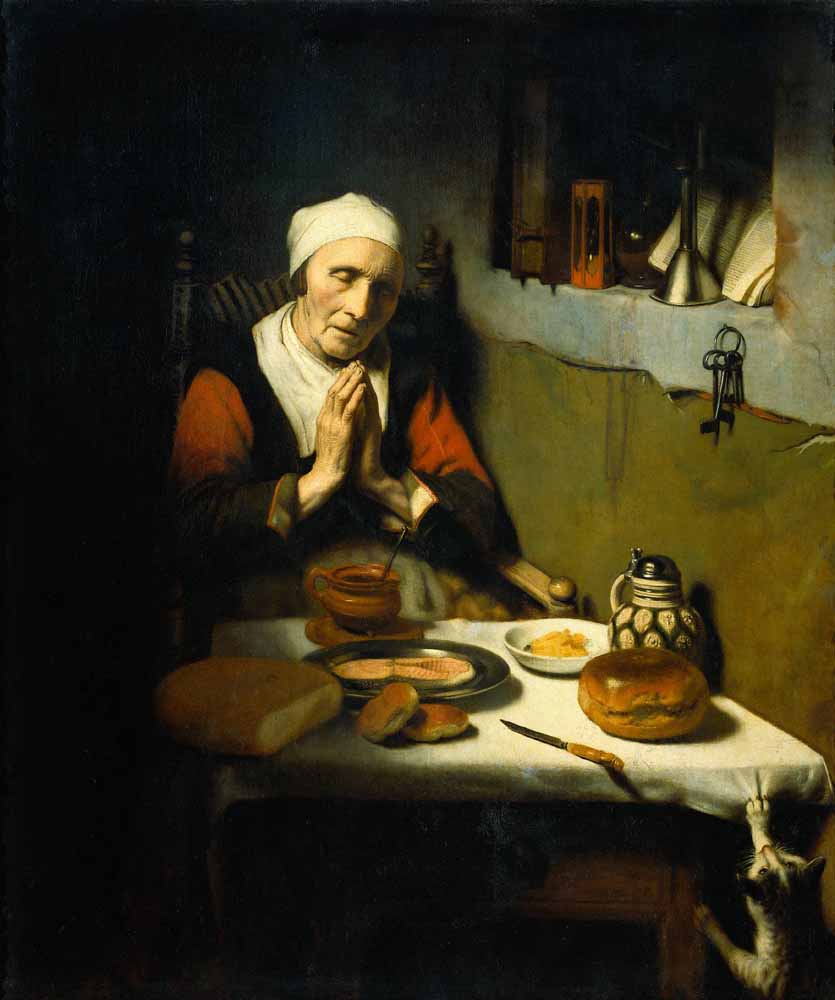
Nicholas Maes, "Old Woman at Prayer" (1656)
Nicolaes Maes (Dutch painter, 1634-1693), detail of "Old Woman at Prayer," known as "Prayer without End" (1656), oil on canvas, 134 x 113 cm, Rijksmuseum, Amsterdam. Larger image.
A Savior comes to rescue people in danger, preserve those who are threatened by harm, and protect his people from the troubles that surround them. That's what saviors do! That's what Jesus came to do for us.
Do not be afraid because God has sent a Savior to us -- Jesus Christ the Lord. He is the One who will:
  • Never leave us or forsake us.7
  • Supply all our needs according to his riches in glory.8
  • Add to us all the things we need as we seek him and his Kingdom.9

Christmas Is About a Savior

Our world doesn't know. They think that Christmas is about gifts under a tree and a spirit of good cheer, with Christmas dinner and family around the table. But as good as all that may be, it isn't nearly as good as the Real Christmas.
The Real Christmas message is this: God has sent a Savior for you. To save you from your sins and to help you in this life -- to lift your burden and ease your fears. That's it! A Savior who is Christ the Lord -- God himself!

The Angel Gabriel's Most Sensitive Mission


As the tall, stately angel rose and walked toward the front of the chapel, there was a buzz among the cadets. Gabriel was a living legend. He cleared his throat.
I've been asked to speak to you today about what I've learned throughout my career. Foremost is this: we are servants of the Most High God. This lesson I learned not during my days here at the academy, but from a human being, a girl.
I had been summoned before God to be briefed on a new mission. He told me:
"Gabriel, you have a most delicate assignment. I am sending my Son to redeem the earth. To do this he must become a human himself. Your mission is to announce this plan to the young woman I have chosen to be his mother.
"Her name is Mary. She lives in the village of Nazareth in Galilee. She is betrothed to be married. That means that she is already considered a wife, though she is living at home until the final ceremonies a few months from now. And Gabriel ... she is a virgin."
He went on to describe my role and brief me on the various contingencies, concluding with these words. "Gabriel, by all means, be gentle."
I arrived one spring morning as Mary was climbing the path from the well and came to where I was sitting on a large boulder.
She's only a child, I thought when I first saw her -- only twelve or thirteen. Betrothed at that age? But such were the customs of that place and I was assured that the Father knows what he is doing. As she approached, I stood, dressed as I always dress -- long white robe, golden sash, and so forth.
"Greetings, Mary," I began.
She gasped.
"Hail, you who are highly favored! The Lord is with you!"
All the color drained from her face. I motioned for her to sit. She carefully removed the full water jug from her head, set it down, then eased herself onto the far end of the rock.
"Don't be afraid, Mary," I said. "You have found favor with God." I waited a moment for her to calm down.
"You will conceive in your womb and bear a son. You are to name him Jesus." She appeared stunned by these words, but I continued.
"Your son will become a great man. He will be called the Son of the Most High God. What's more, the Lord God will give him the throne of David his ancestor. And he will reign as Messiah over Israel forever. Of his kingdom and reign there will be no end!"
I paused. The message shocked me; I couldn't imagine the impact it must have had on her! She was quiet for a time. Then she asked in her young teenager voice:
"How will this happen, since I am not yet married?"
I answered:
"The Holy Spirit will come to you,
The Power of the Most High will overshadow you,
Therefore your son to be born will be holy,
He will be called 'Son of God.'"
Amazing! The Father was prepared to rest his entire Christ-enterprise on this young girl -- her response, her whim, her decision. She was to be the mother of God's own Son -- so young. I continued to reassure her.
"And now, your relative Elizabeth in her old age has conceived a son."
Mary murmured, "Old Elizabeth? Really? Oh!" I could see just a glimmer of a twinkle return to her eyes.
"Yes, they called her 'barren,' but she's already six months pregnant."
Mary was almost grinning for a moment. Then I saw her smile fade. I couldn't read her thoughts, but could only imagine what she must be thinking.
How could she ever explain this to anyone? Who wouldunderstand? Who would ever believe her? Her father would be furious, her mother deeply hurt. And Joseph? There would be no wedding. Her dreams of marriage and family vanished in an instant. And the town fathers? Would they try to stone her?
I had been given one sentence by the Father with which to respond: "Nothing will be impossible with God," I said. "Nothing!"
She was quiet a moment longer, lost in her thoughts. Then she looked up at me with clear eyes and said intently: "Here I am. I am the Lord's servant, his handmaid. Let what you have said come to pass."
She stood up. As she began to lift the heavy water jug to her shoulder and then hoist it up to her head, I reached to help, but she shook her head and lifted it up herself. As she made her way up the path to the village, her steps were assured, almost a spring to them. At the top of the hill she steadied the jar with one hand and waved to me with the other. Then she was lost from view.
And that is how I met Mary. She taught me what it means to be a servant when it's hard to obey, when there seems to be no hope except God's promise. Mary took the words, "For nothing will be impossible with God," and believed them. Whenever I struggle with obedience, I think of this young girl who began a servant's journey with the words:
"I am the servant, the handmaid of the Lord. Let it be! Let it come! I am His servant."
The tall angel touched the corner of his eye for a moment, then stepped down and took his seat. Gabriel had learned servanthood from an even greater servant than himself -- a young virgin from Nazareth named Mary.


An Ancient Holiday Saturnalia


The middle of winter has long been a time of celebration around the world. Centuries before the arrival of the man called Jesus, early Europeans celebrated light and birth in the darkest days of winter. Many peoples rejoiced during the winter solstice, when the worst of the winter was behind them and they could look forward to longer days and extended hours of sunlight.

In Scandinavia, the Norse celebrated Yule from December 21, the winter solstice, through January. In recognition of the return of the sun, fathers and sons would bring home large logs, which they would set on fire. The people would feast until the log burned out, which could take as many as 12 days. The Norse believed that each spark from the fire represented a new pig or calf that would be born during the coming year.
The end of December was a perfect time for celebration in most areas of Europe. At that time of year, most cattle were slaughtered so they would not have to be fed during the winter. For many, it was the only time of year when they had a supply of fresh meat. In addition, most wine and beer made during the year was finally fermented and ready for drinking.
In Germany, people honored the pagan god Oden during the mid-winter holiday. Germans were terrified of Oden, as they believed he made nocturnal flights through the sky to observe his people, and then decide who would prosper or perish. Because of his presence, many people chose to stay inside.

Saturnalia

In Rome, where winters were not as harsh as those in the far north, Saturnalia—a holiday in honor of Saturn, the god of agriculture—was celebrated. Beginning in the week leading up to the winter solstice and continuing for a full month, Saturnalia was a hedonistic time, when food and drink were plentiful and the normal Roman social order was turned upside down. For a month, slaves would become masters. Peasants were in command of the city. Business and schools were closed so that everyone could join in the fun.
Also around the time of the winter solstice, Romans observed Juvenalia, a feast honoring the children of Rome. In addition, members of the upper classes often celebrated the birthday of Mithra, the god of the unconquerable sun, on December 25. It was believed that Mithra, an infant god, was born of a rock. For some Romans, Mithra's birthday was the most sacred day of the year.
In the early years of Christianity, Easter was the main holiday; the birth of Jesus was not celebrated. In the fourth century, church officials decided to institute the birth of Jesus as a holiday. Unfortunately, the Bible does not mention date for his birth (a fact Puritans later pointed out in order to deny the legitimacy of the celebration). Although some evidence suggests that his birth may have occurred in the spring (why would shepherds be herding in the middle of winter?), Pope Julius I chose December 25. It is commonly believed that the church chose this date in an effort to adopt and absorb the traditions of the pagan Saturnalia festival. First called the Feast of the Nativity, the custom spread to Egypt by 432 and to England by the end of the sixth century. By the end of the eighth century, the celebration of Christmas had spread all the way to Scandinavia. Today, in the Greek and Russian orthodox churches, Christmas is celebrated 13 days after the 25th, which is also referred to as the Epiphany or Three Kings Day. This is the day it is believed that the three wise men finally found Jesus in the manger.
By holding Christmas at the same time as traditional winter solstice festivals, church leaders increased the chances that Christmas would be popularly embraced, but gave up the ability to dictate how it was celebrated. By the Middle Ages, Christianity had, for the most part, replaced pagan religion. On Christmas, believers attended church, then celebrated raucously in a drunken, carnival-like atmosphere similar to today's Mardi Gras. Each year, a beggar or student would be crowned the "lord of misrule" and eager celebrants played the part of his subjects. The poor would go to the houses of the rich and demand their best food and drink. If owners failed to comply, their visitors would most likely terrorize them with mischief. Christmas became the time of year when the upper classes could repay their real or imagined "debt" to society by entertaining less fortunate citizens.

An Outlaw Christmas

In the early 17th century, a wave of religious reform changed the way Christmas was celebrated in Europe. When Oliver Cromwell and his Puritan forces took over England in 1645, they vowed to rid England of decadence and, as part of their effort, cancelled Christmas. By popular demand, Charles II was restored to the throne and, with him, came the return of the popular holiday.
The pilgrims, English separatists that came to America in 1620, were even more orthodox in their Puritan beliefs than Cromwell. As a result, Christmas was not a holiday in early America. From 1659 to 1681, the celebration of Christmas was actually outlawed in Boston. Anyone exhibiting the Christmas spirit was fined five shillings. By contrast, in the Jamestown settlement, Captain John Smith reported that Christmas was enjoyed by all and passed without incident.
After the American Revolution, English customs fell out of favor, including Christmas. In fact, Congress was in session on December 25, 1789, the first Christmas under America's new constitution. Christmas wasn't declared a federal holiday until June 26, 1870.